
£75fixed price
Targeted Roof Inspection
One specific area, such as a chimney, a gulley or suspected missing tiles.
- One area of the roof
- Selected digital photographs
- Brief summary of visible observations
Plymouth is our home patch. We inspect slate terraces, chimney stacks, valley gutters and flat roofs across the city, with photos and 4K video and no scaffolding.
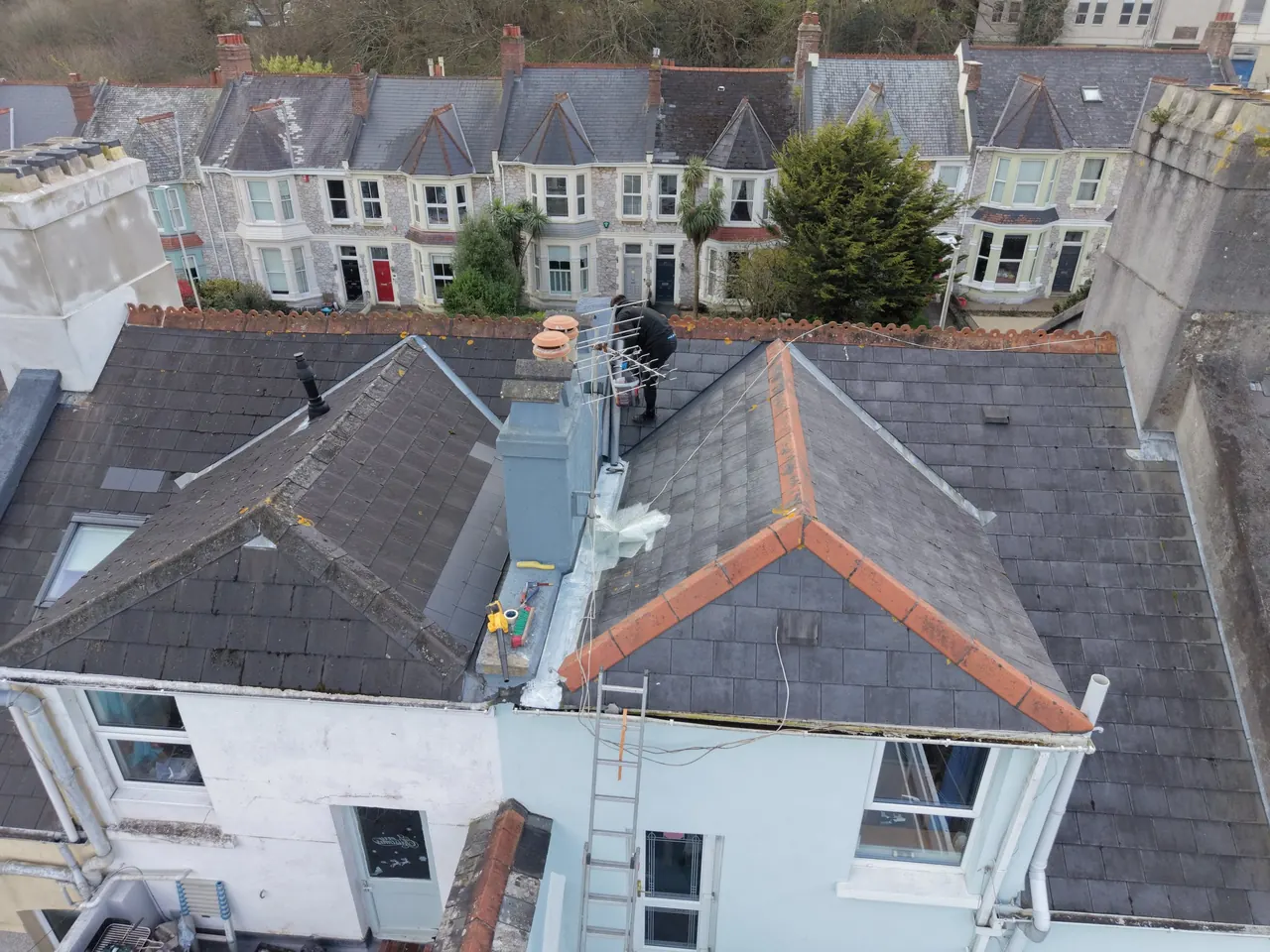
One specific area, such as a chimney, a gulley or suspected missing tiles.
Every safely accessible and visible slope, chimney, flashing, valley and gutter.
The full inspection plus a PDF your roofer, surveyor or insurer can act on.
Much of Plymouth's housing outside the centre was built in the late 19th and early 20th centuries: the long terraces of Mutley, Lipson, Stoke, Peverell, Milehouse and St Judes. Most carry natural slate roofs, with brick or rendered chimney stacks shared between neighbours and lead flashing where stack meets slate.
From the street these roofs often look tidy. The trouble tends to be where you can't see it: at the back, where rear wings and outshots create lead-lined valley gutters and gulleys between slopes. Those valleys collect leaves, moss and silt, and when the lead splits or a joint lifts, water gets in, often showing up on a ceiling some distance from the actual fault. Our job on Milehouse Road was exactly that: a leak above a staircase, traced from the air to a lead-lined gulley that Tom Duggan Roofing then replaced. On a terrace, a drone can also look at shared chimney stacks and party-wall details without anyone climbing onto a neighbour's roof. See our gutter and valley inspections and chimney inspections.
The bombing raids of March and April 1941 destroyed most of Plymouth's city centre. Rebuilding began in 1948 to Abercrombie and Paton Watson's Plan for Plymouth, which is why the centre is now a conservation area in its own right, with 1950s commercial blocks along Armada Way and Royal Parade and their flat and low-pitched roofs. After the war the city also grew outwards: Southway was built from the mid-1950s to the late 1960s and Estover in the 1970s, and Plymstock and Plympton joined the city in 1967.
Roofs from this period have different weak points from Victorian slate. Expect concrete interlocking tiles on mortar-bedded ridges, felt or asphalt flat roofs over extensions and garages, and box gutters on commercial buildings. Flat roofs hold standing water, and mortar ridges crack and loosen after decades of wind. A full roof visual inspection records every slope and flat section, so you can see what needs attention now and what can wait. If you manage several properties across the city, see inspections for landlords and agents.
Plymouth has 15 conservation areas, including the Barbican, the Hoe, Stonehouse Peninsula, Devonport, Mannamead and Stoke, and many of the buildings in them are listed. A drone inspection doesn't touch the roof, so it needs no consent. Repairs to a listed building, or visible changes in a conservation area, may need permission from Plymouth City Council, and clear photos of the existing roof help that conversation.
Homes on the Hoe, in Stonehouse and along the waterfront take the full force of south-westerly gales off the Sound, and salt air is hard on lead, mortar and metal fixings. After a big storm, a targeted check of one ridge or chimney is a quick way to find out whether anything has moved.
Plymouth is also a naval city, and Ministry of Defence sites, including Devonport Naval Base, are protected by drone restrictions. We check airspace and any restrictions before every flight. If your address is affected, we'll tell you before you book.
Yes. The drone flies above your property and photographs your roof, the shared chimney stack and the valleys at the back without anyone stepping onto the roofs next door. We take off from your property or a safe open space nearby and keep the camera on your roof rather than your neighbours' gardens.
Yes. A drone inspection doesn't touch the roof, so it needs no planning or listed building consent. If the photos show repairs are needed, work on a listed building, or work that changes how a building looks in a conservation area, may need consent from Plymouth City Council. Our photos give you, your roofer and the council a clear record of the roof as it is.
Devonport Naval Base is a Ministry of Defence site with drone restrictions around it. We check the current airspace restrictions for every address before we confirm a booking. If your property falls inside a restricted area, we'll tell you straight away, rather than turning up on the day and finding we can't fly.
Yes. All of our published case studies are in Plymouth, including Plymstock Road, Fircroft Road, Torr Lane and Milehouse Road. They range from a check for missing tiles to tracing a staircase leak to a failed lead gulley. You can see the photos and outcomes on our recent inspections page.
Postcodes: PL1, PL2, PL3, PL4, PL5, PL6
within about 20 minutes of Plymouth city centre for most city addresses
Send the address area and what you are worried about. We reply within one working day with options and a fixed price.
Prefer to talk it through? Book a free 15-minute call and we will help you choose the right inspection.