Yes. Drone roof inspections are legal in the UK when the operator holds a CAA Operator ID, the pilot has a Flyer ID and, for most drones flown near houses, an A2 CofC or a GVC-backed authorisation, third-party insurance is in place, airspace is checked and images are handled lawfully. Homeowners usually just give permission to take off.
Key takeaways
- A professional inspector needs a CAA Operator ID, a Flyer ID and, for most drones flown near houses, an A2 CofC or an operational authorisation backed by a GVC or RPC-L1.
- Third-party insurance is a legal requirement for any commercial drone flight; it is optional only for hobby flying.
- Since 1 January 2026, new drones carry UK class marks and UK1 to UK3 drones must broadcast Remote ID; more drones follow on 1 January 2028.
- Parts of Plymouth around HMNB Devonport are restricted airspace, so every job starts with an airspace check.
- Photos that identify people fall under UK GDPR, so ask how images are stored, shared and deleted.
Short answer: yes. A drone roof inspection is legal in the UK when the operator is registered with the Civil Aviation Authority (CAA), the pilot is qualified to fly near houses, the business has third-party insurance, the airspace has been checked, and photos are handled lawfully. As a homeowner, you usually only need to let the drone take off from your property. Here is each rule as of November 2026, and what to ask before you book.
Are drone roof inspections legal in the UK?
Yes, provided the flight follows the CAA's rules. Roof inspections are flown in the CAA's Open category or under a Specific category authorisation, and both allow paid work. The rules control who may fly, which drones, how close to people, how high and where. Flying for money adds insurance.
What CAA registrations does a drone inspector need?
Two IDs: an Operator ID for the business responsible for the drone, and a Flyer ID for the person flying it. It is against the law to fly without the IDs your drone requires.
- Operator ID. Required for any drone of 100 g or more that has a camera, which covers every inspection drone. The Operator ID must be labelled on every drone the business flies.
- Flyer ID. Required for anyone flying a drone of 100 g or more (older guidance often said 250 g). The pilot passes the CAA's online theory test, and the ID lasts five years.
These are the minimum. Flying a larger drone close to houses needs a further qualification.
Which qualification lets a pilot fly close to houses?
It depends on the drone. On a residential street, the pilot will use a drone under 250 g or with a UK1 class mark, hold an A2 Certificate of Competency (A2 CofC), or fly under a CAA operational authorisation backed by a GVC or Level 1 Remote Pilot Certificate (RPC-L1).
| Route | Drones | Distance from uninvolved people | Qualification |
|---|---|---|---|
| Open category, "Over people" (A1) | Under 250 g, or UK0/UK1 class | May fly over uninvolved people, never over crowds | Flyer ID and Operator ID |
| Open category, "Near people" (A2) | UK2 class (or C2), or legacy drones under 2 kg | 30 m for UK2/C2 class (5 m in low-speed mode); 50 m for legacy drones under 2 kg | A2 CofC, Flyer ID and Operator ID |
| Open category, "Far from people" (A3) | Up to 25 kg | 50 m from people and 150 m from residential, commercial, industrial and recreational areas | Flyer ID and Operator ID |
| Specific category, PDRA01 authorisation | Under 25 kg | 50 m, reduced to 30 m for take-off and landing; may fly within 150 m of residential areas | GVC or RPC-L1, plus a CAA authorisation renewed every 12 months |
A3 is no use for most houses because of the 150 m rule. The A2 CofC lasts five years. The CAA will stop issuing GVCs on 31 December 2027 in favour of the RPC-L1; existing GVCs remain valid until expiry where the authorisation accepts them.
What does "uninvolved people" mean on a residential street?
Anyone not taking part in the flight. A good pilot chooses the take-off spot carefully, times the flight around passers-by, asks the household to stay clear and pauses when someone walks past. That is why a professional inspection takes a little planning.
What changed for drones in 2026?
UK class marks and Remote ID arrived on 1 January 2026. Any new drone model placed on the market from that date must carry a UK class mark (UK0 to UK6). Remote ID broadcasts the drone's identity and position in flight, so anyone with a receiver can see who is responsible.
- 1 January 2026: Remote ID required for UK1, UK2 and UK3 class drones.
- 1 January 2028: Remote ID required for legacy (non-class-marked) and privately built drones of 100 g or more with a camera, and for UK0 drones of 100 g or more with a camera. European C-class drones become "legacy" in the UK from the same date.
How high can a drone fly, and how close to buildings?
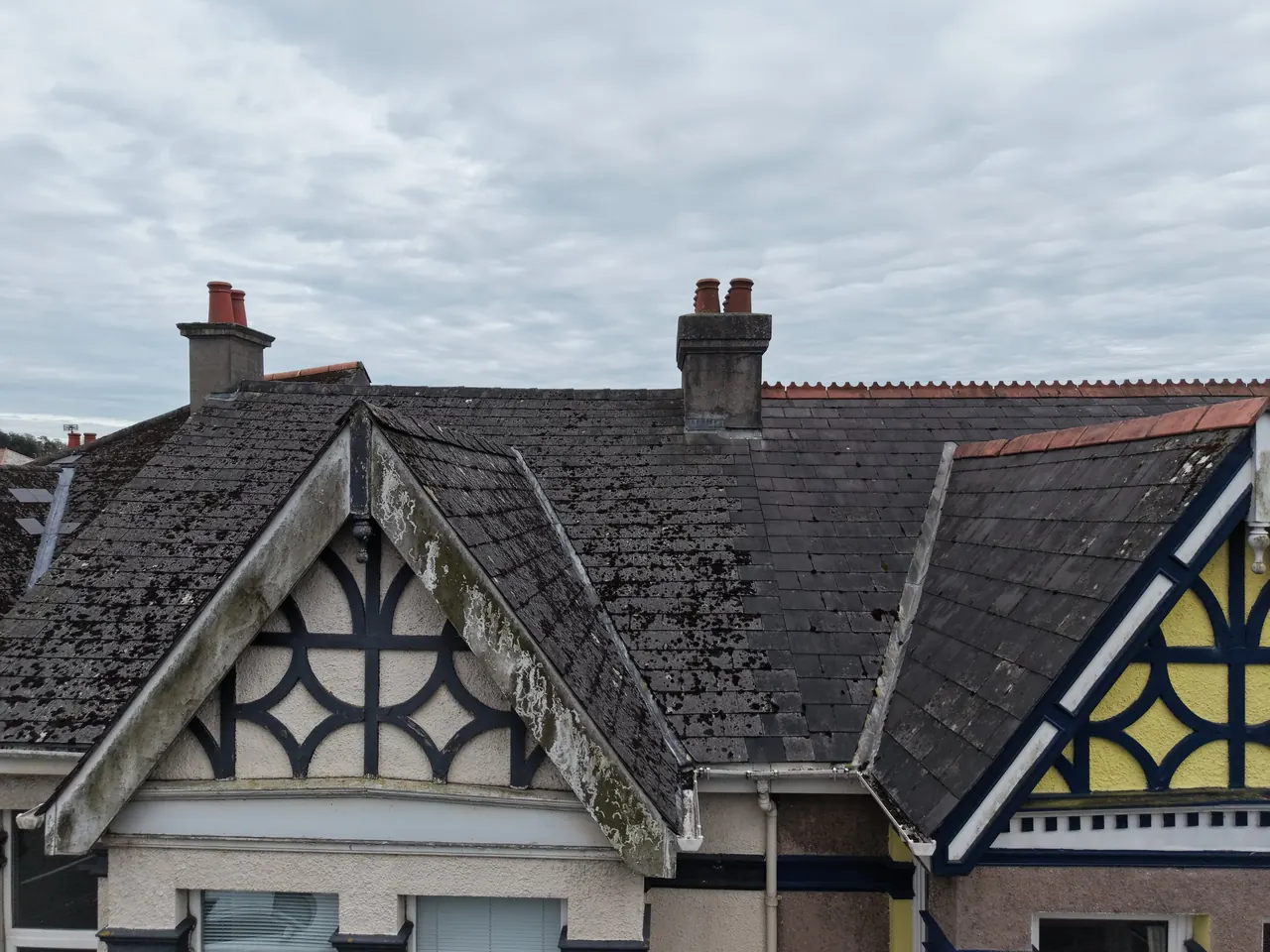
The legal height limit is 120 m (400 ft). Roof inspections are flown far lower, usually a few metres above the ridge.
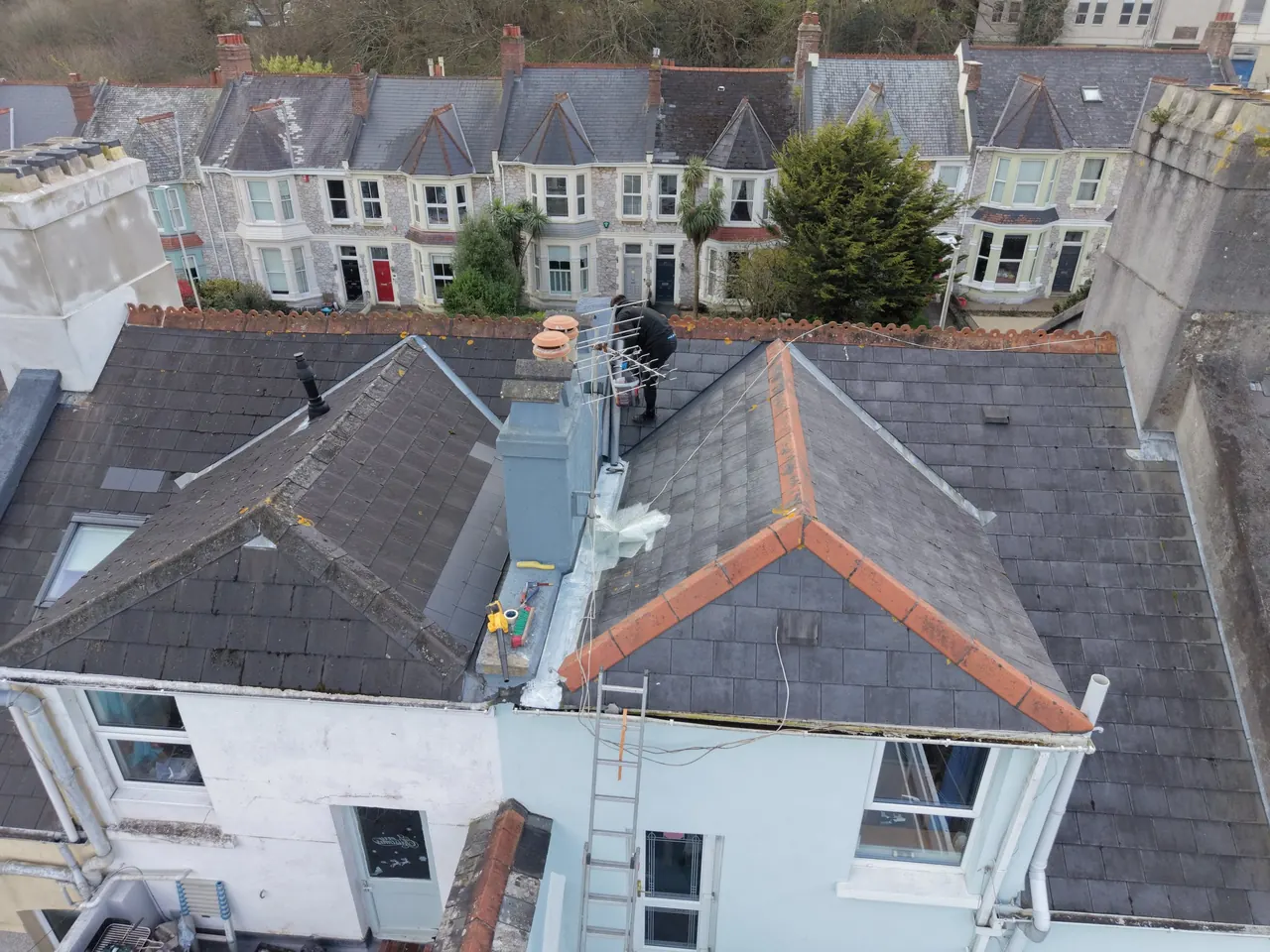
In the Open category the distance rules concern people and, under A3, built-up areas, not a fixed distance from a building. The pilot keeps safe clearance from chimneys, aerials, trees and cables. Coastal gusts in Plymouth often decide the day; if conditions are unsafe, we reschedule.
Does a drone inspector need insurance?
Yes. The CAA says that if you fly a drone for any commercial reason, ‘you must have third party insurance as a minimum’. Getting paid to take photos or carry out surveys is commercial.
The cover must meet assimilated Regulation 785/2004, applied through the Civil Aviation (Insurance) Regulations 2005. It is optional only for recreational, sport or hobby flying. Public liability and professional indemnity cover are good practice, not aviation-law requirements. Ask to see the certificate and check it is in date, in the business's name and covers commercial drone operations.
Can a drone inspection invade my neighbours' privacy?
It should not, and the law expects the operator to take care. The CAA warns that photos or recordings in which people could be identified may be covered by UK data protection law, whether those people were filmed deliberately or not.
A business flying for paid work is a data controller under UK GDPR and the Data Protection Act 2018. The Information Commissioner's Office (ICO) has guidance on drones, and the CAA's Drone Code adds duties: tell people before recording where practical, think before sharing, store images safely and delete what you do not need. For a roof inspection, that means:
- pointing the camera at your roof, not at neighbouring gardens or windows;
- removing or blurring any frames that show identifiable people before images are shared;
- sharing images only with you, and with your roofer or agent if you ask;
- keeping files securely and deleting them after an agreed period.
Our own retention period and data handling are set out in our privacy notice to confirm: retention period for inspection photos and video, e.g. 12 months, and whether the business has paid the ICO data protection fee.
Do I need to tell my neighbours?
There is no general legal requirement for neighbours' consent to a short roof inspection, but on a terrace we recommend a quick word, as adjoining roofs often appear at the edges of shots. If we need to take off from a neighbour's drive or garden, we ask them first.
Can drones fly anywhere in Plymouth?
No. Parts of Plymouth, on both sides of the Tamar, sit inside permanent restricted airspace around HM Naval Base Devonport, where drones may not fly without permission.
According to the UK Aeronautical Information Publication (AIP), published by NATS:
- EGR002 Devonport is a restricted area of 1 nautical mile (about 1.85 km) radius around the naval base, from the surface to 2,000 ft, under the Air Navigation (Restriction of Flying) (Nuclear Installations) Regulations 2016. It covers the dockyard and surrounding streets, including parts of Devonport, Keyham, Ford, Morice Town and, across the river, Torpoint.
- EGR1U087 and EGR1U088, "NSA HMNB Devonport" Areas 1 and 2, are restricted around the clock for unmanned aircraft from the surface to 600 ft under the Air Navigation (Restriction of Flying) (Ministry of Defence Prohibited Places) Regulations 2026, which came into force on 19 February 2026.
- A further zone, EGR1U093 "NSA Plymouth", applies to another defence site in the north-west of the city.
- Offshore and along the coast at Wembury, military danger areas are active at published times or when activated by NOTAM (Notice to Aviation).
Temporary restrictions can appear at short notice for events or emergencies, and byelaws can restrict take-off from parks. We check official airspace sources and NOTAMs before every job. If your address is inside a restricted zone, we will tell you before booking whether we can seek permission or whether a ladder or access equipment is the better option. We would rather turn a job down than fly where we should not.
What should you ask your drone inspector?
Ask for proof of an Operator ID, the pilot's competence and insurance, plus a site risk assessment and a clear answer on what happens to the images.
| Ask about | Why it matters | A good answer |
|---|---|---|
| CAA Operator ID | Shows the business is registered and accountable | An ID they quote readily, also labelled on the drone |
| Flyer ID and A2 CofC, or GVC/RPC-L1 with an operational authorisation | Shows the pilot may legally fly close enough to inspect a house | A named qualification and expiry date; for a PDRA01, a current authorisation |
| Insurance certificate | Third-party cover is a legal requirement for paid work | A certificate in the business's name, in date, covering commercial drone operations |
| Risk assessment and airspace check | Every street has different hazards, and parts of Plymouth are restricted | A site-specific plan covering take-off point, people, cables, weather and airspace |
| Data handling | Footage may show neighbours or people in the street | Who sees the images, how they are stored and when they are deleted |
| What the report covers | A drone inspection is visual, not structural | A clear statement of what was seen, what could not be seen, and any limitations |
For the record, our details are: CAA Operator ID to confirm: Operator ID; pilot competence to confirm: Flyer ID / A2 CofC / GVC or RPC-L1 and any operational authorisation; insurance to confirm: insurer and third-party liability limit. We are happy to send copies before you book. More about how we work is on our about page.
What does a homeowner need to do before a drone roof inspection?
Usually nothing beyond letting the drone take off from your drive, garden or forecourt. You do not need to apply to the council or the CAA. It helps if you tell us:
- where the problem is, if you know: a stain on a ceiling, a damp chimney breast, a dripping gutter;
- where we can safely set up, and whether there are pets or children in the garden;
- whether neighbours share the chimney or valley in question;
- if the property is rented, who the tenant is, so that they can be told in advance.
The rest is our job. A full roof inspection is £150, a targeted check of one area is £75, and an annotated PDF report is £200 (see pricing). For specific problems, see roof leak investigation and chimney inspection, or examples in our recent inspections.
Next step
If you are in Plymouth or nearby, contact us for a free 15-minute call. Give us your postcode and we will check the airspace, tell you honestly whether a drone is the right tool, and send our registration and insurance details before you book. Landlords may also want our landlord roof maintenance guide.
Frequently asked questions
Can I fly my own drone to look at my roof?
Possibly, but check the rules first. You need a Flyer ID for drones of 100 g or more and an Operator ID if it has a camera. A drone of 250 g or more without a UK1 class mark, flown without an A2 CofC, falls under rules that keep it 150 m from residential areas, which rules out most homes. Under 250 g is simpler, though the camera may struggle in wind.
Can the drone see into my house or my neighbours' homes?
It is not used that way. The camera is pointed at the roof, chimneys and gutters, and we do not film into windows or gardens. Where a frame happens to show a person or a neighbour's garden, we remove or blur it before sharing. Footage goes only to you, and to your roofer or agent if you ask.
What happens if a drone damages my roof or car?
That is exactly what third-party insurance is for, which is why it is a legal requirement for commercial flights. Before booking, ask to see the certificate and check it covers commercial drone work. Pre-flight checks, a planned take-off spot and keeping clear of cables and aerials keep the risk low, but the cover should be there regardless.
Why might a drone inspection be postponed?
Usually the weather: strong or gusty wind, rain or poor visibility. Occasionally a temporary airspace restriction appears at short notice, for example for an emergency or an event. If either happens, we contact you, explain why and agree a new date. We will not fly in conditions that make the inspection unsafe or the photos unreliable.
Sources
- Registering to fly drones and model aircraft (CAA)
- Introduction to more advanced flying: Open category subcategories (CAA)
- A2 Certificate of Competency (CAA)
- Level 1, 2 and 3 Remote Pilot Certificates and GVC (CAA)
- PDRA01 overview (CAA)
- Class marks (CAA)
- Remote ID (CAA)
- The Drone and Model Aircraft Code: where you can fly (CAA)
- Insurance requirements for drones (CAA)
- Privacy rules when flying drones (CAA)
- Drones: your data matters (ICO)
- Airspace restrictions (CAA)
- UK Aeronautical Information Publication, ENR 5.1 (NATS)
- The Air Navigation (Restriction of Flying) (Ministry of Defence Prohibited Places) Regulations 2026
- The Air Navigation (Restriction of Flying) (Nuclear Installations) Regulations 2016