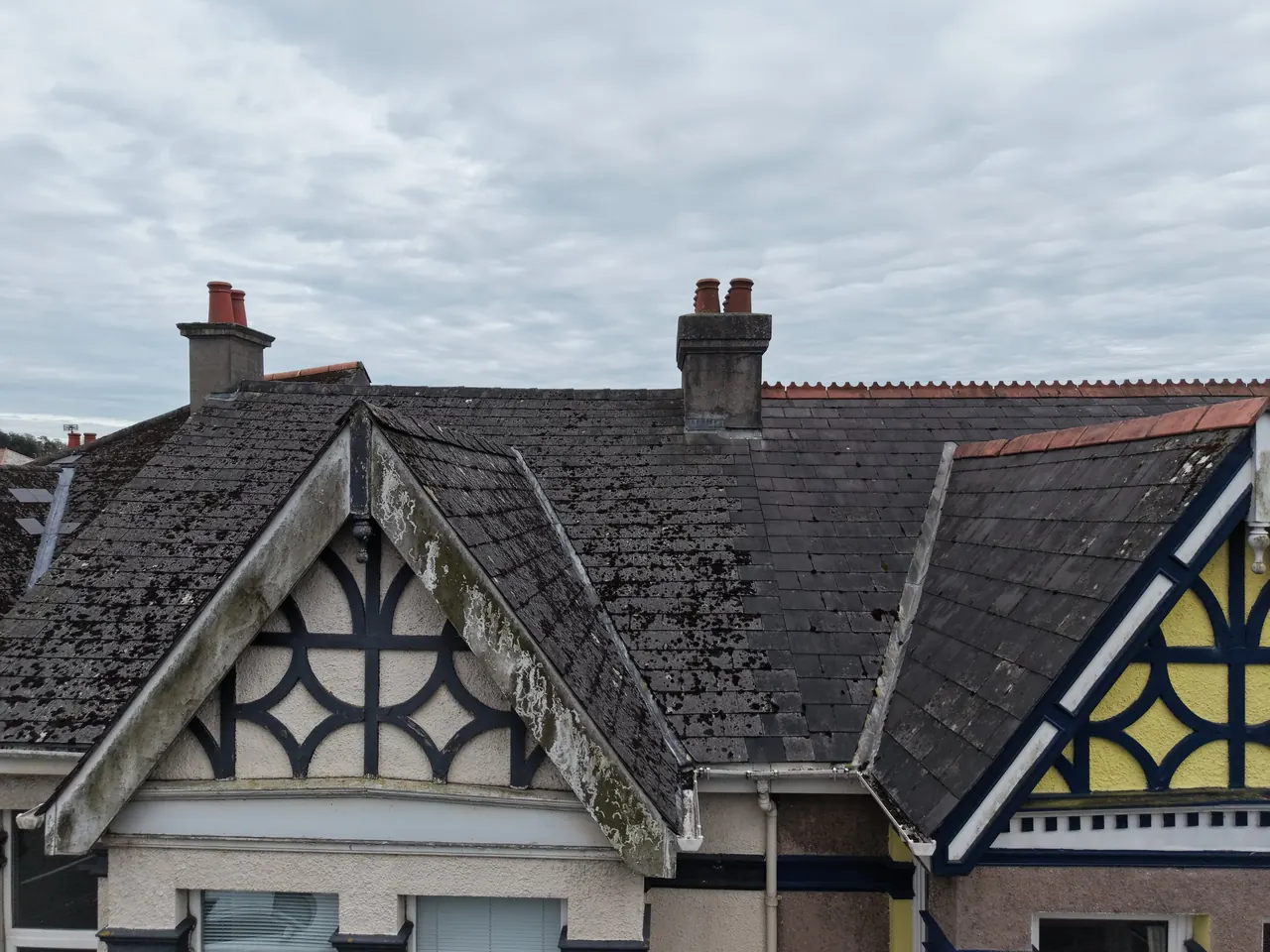
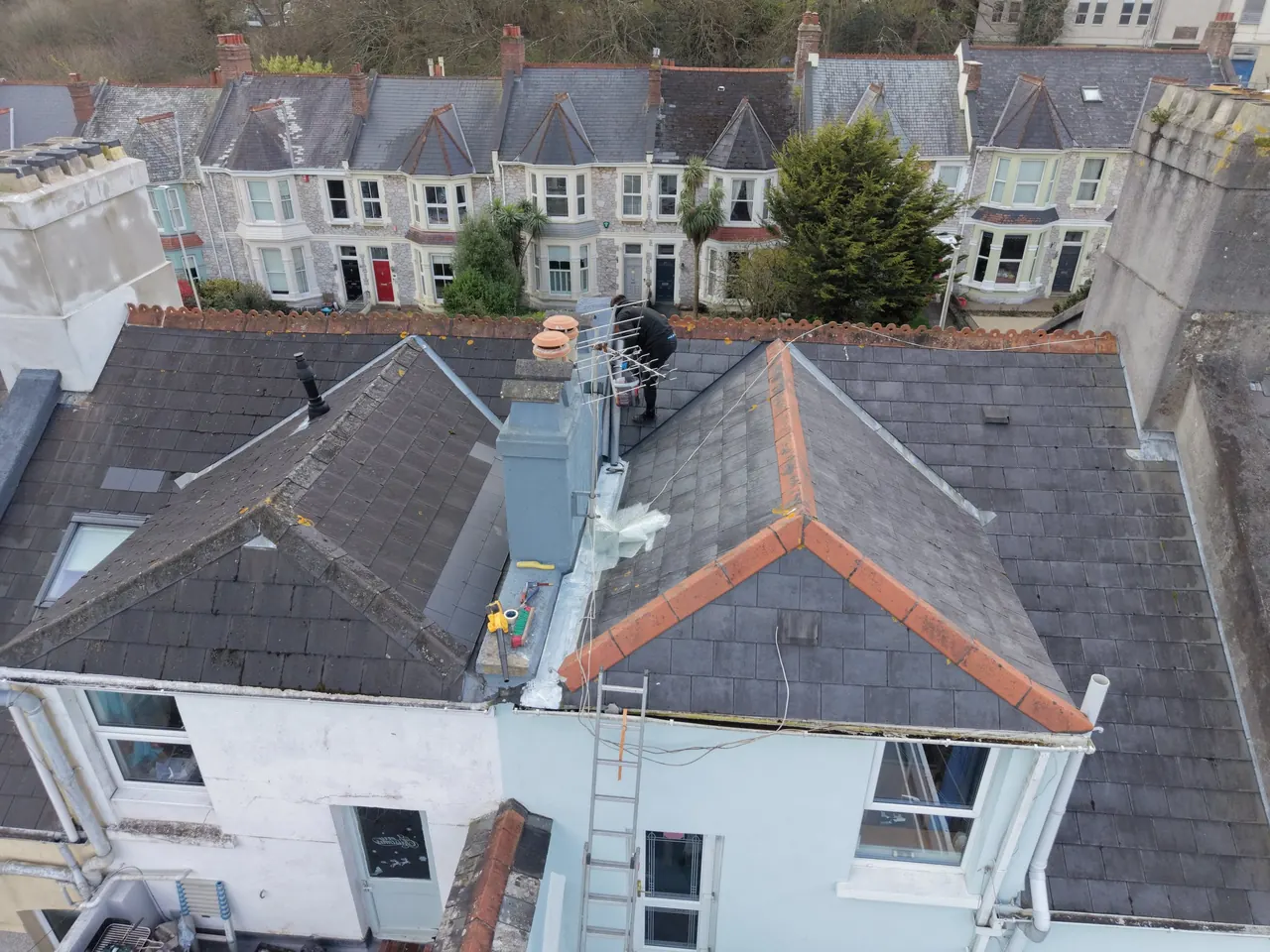
Get the roof checked between your offer being accepted and exchange of contracts. RICS surveys at all three levels view roofs and chimneys from the ground, plus the loft from inside, so rear slopes, valleys and flashing often go unseen. A drone check costing £75 to £200 shows them close up, giving you evidence to renegotiate or request repairs.
Key takeaways
- All three RICS survey levels view the outside of the roof from the ground, with binoculars.
- On Plymouth terraces, rear slopes, chimney backs, valleys and gulleys are hidden from the street.
- Book the roof check after your survey and before exchange, while you can still negotiate.
- Labelled photos plus a roofer's written quote are the strongest basis for a price reduction.
- A drone check costs £75 to £200; a new tiled roof can cost £7,000 to £21,000 (Which?).
Your survey will cover the roof, but usually from the pavement, the garden and the loft hatch. On a Plymouth terrace that leaves the parts most likely to cost money, the back of the chimney, the valleys and the lead gulleys, largely unseen. This guide explains what each RICS survey level actually does on a roof, what a drone adds, and how to use the findings before you are committed.
Does a house survey check the roof?
Yes, but mostly from the ground and from inside the loft. At all three RICS levels, pitched roofs and chimneys are viewed from below, with binoculars where needed.
The RICS Home Survey Standard has three levels. The published descriptions are specific about roofs. At Level 3, the most detailed survey, RICS says: "We visually inspect roofs, chimneys and other surfaces on the outside of the building from ground level and, if necessary, from neighbouring public property and with the help of binoculars." The same descriptions limit ladders to flat roofs and hatches no more than 3 m above level ground or the floor.
| Survey | Outside of the roof | Roof space (loft) | Typical cost (HomeOwners Alliance, 2026) |
|---|---|---|---|
| RICS Level 1 | From ground level and neighbouring public property, with binoculars | Viewed from the access hatch; insulation and stored goods not moved | £300+ |
| RICS Level 2 | From ground level and neighbouring public property, with binoculars | Surveyor enters if safe and reasonable; insulation and contents not moved | £400+ |
| RICS Level 3 | From ground level and neighbouring public property, with binoculars | Surveyor enters if safe; may lift small corners of insulation | £630+ |
| Drone roof inspection | Close-up photos and 4K video from above, all visible slopes | Not covered | £75-£200 |
None of this is a criticism of surveyors. A survey covers the whole house, from damp to drains, and the loft is a good place to spot a leaking roof from below. HomeOwners Alliance notes that surveyors usually check the loft for exactly that reason. The gap is the outside of the roof that cannot be seen from the street, and a drone fills it. It does not replace your survey. Our comparison of drone and scaffolding inspections explains the trade-offs.
Why does the roof matter more on an older Plymouth terrace?
Because older roofs have more joints, more lead and more years of weather behind them, and on a terrace much of that is out of sight from the road.
Many Plymouth streets, in areas such as Mutley, Stoke, Peverell and Lipson, are lined with late Victorian and Edwardian terraces. Typical features include natural slate, tall shared chimney stacks, back additions with their own small roofs, and lead-lined gulleys or valleys between neighbouring roofs. Each is a place where water can get in. The city also gets around 1,038 mm of rain a year, with 1 mm or more on about 149 days (Met Office, Plymouth Mountbatten, 1991-2020), so worn joints are tested often.
From the pavement you usually see the front slope and the front of the chimney. The rear slopes, the back of the stack, the valley between the main roof and the back addition, and any gulley behind a parapet are hidden. Our guide to slate roof problems in Plymouth covers the typical defects in more detail.
What does a drone roof check show a buyer?
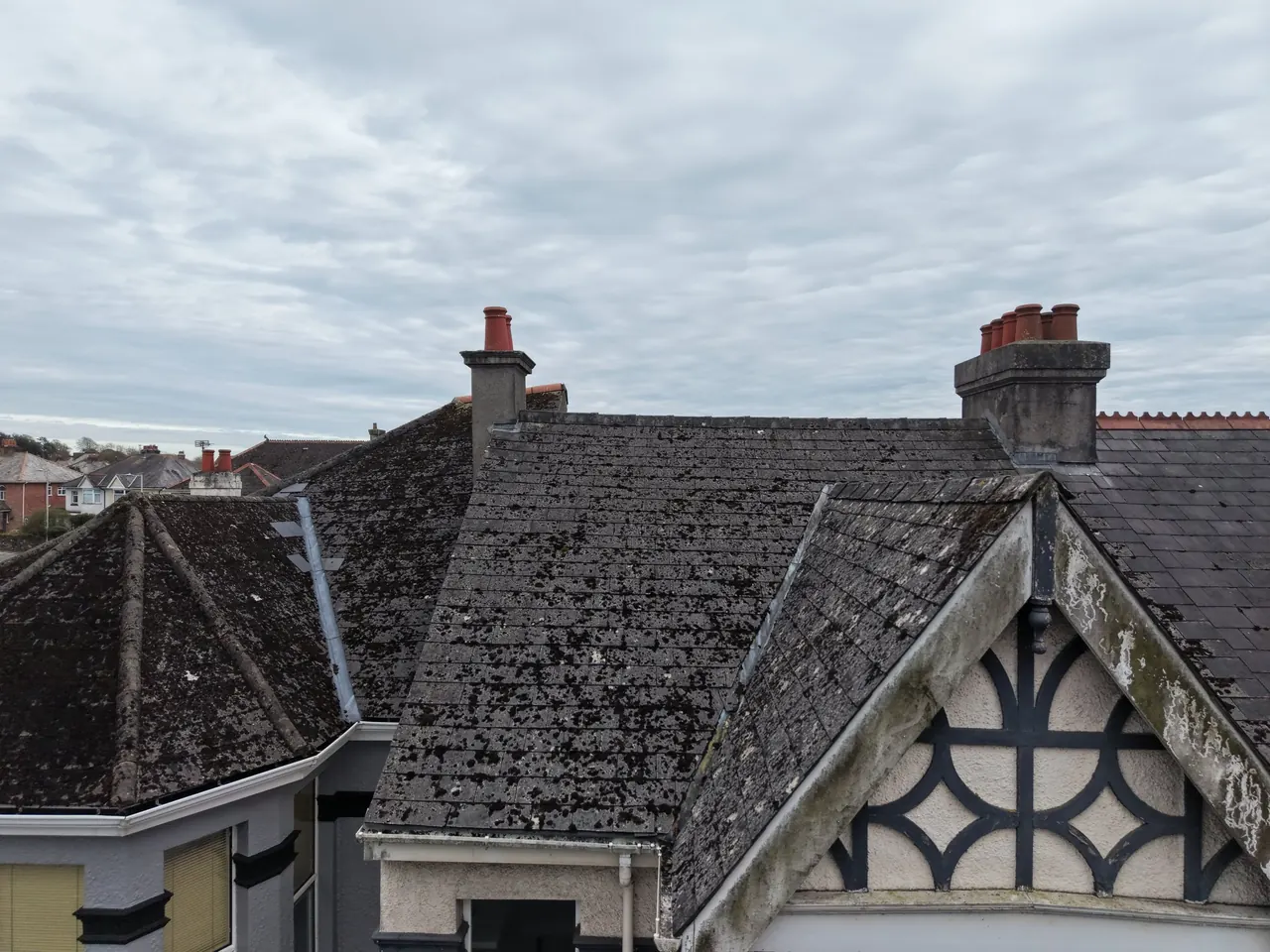
It shows the condition of every visible slope, chimney, valley and gutter in close-up, without scaffolding or anyone walking on the slates.
- Slates: slipped, cracked or missing slates, patched areas, and moss build-up
- Chimneys: pots, flaunching, pointing, and the lead flashing where the stack meets the roof
- Valleys and gulleys: splits in lead, blockages and debris
- Ridge and hips: missing or loose ridge tiles and cracked mortar
- Gutters and edges: blockages, sagging sections and damage at the eaves
- Rooflights and dormers: the condition of flashing and surrounds
The limits are worth stating plainly. A drone inspection is visual. It cannot see under slates, test timber or measure damp, and it is not a structural survey. Flights depend on the weather and on airspace permissions. What it gives you is clear, dated evidence of what can be seen, which is what you need to ask a roofer for a quote. See our pre-purchase roof check for what is included.
When should I get the roof checked?
Between your offer being accepted and exchange of contracts, ideally as soon as your survey report arrives. Before exchange you can still renegotiate, ask for repairs or walk away; after exchange you are legally committed.
- Offer accepted. Book your RICS survey.
- Survey report arrives. Read the roof, chimney and roof space sections, including the "limitations" notes that list what the surveyor could not see.
- Book the drone check. Ask the agent to arrange it with the seller, as you would a second viewing. We need the seller's agreement to fly over their property.
- Get roofing quotes for anything the photos show.
- Negotiate through your solicitor and the agent, before exchange.
Leaving it until after completion still has value. One Torr Lane client booked us after buying, to get an overview of the roof's condition. The photo record helped them prioritise maintenance and plan their budget. Done before exchange, the same photos could also have shaped the price.
What does a roof check cost compared with roof repairs?
A drone roof check costs £75 to £200. Common roof repairs run from a few hundred pounds to several thousand, and a full new roof far more.
| Item | Typical cost | Source |
|---|---|---|
| Targeted Roof Inspection (one area, such as a chimney) | £75 | Westcountry Drone Inspections |
| Full Roof Visual Inspection | £150 | Westcountry Drone Inspections |
| Roof Inspection & Annotated Report | £200 | Westcountry Drone Inspections |
| Replace one to six broken or missing standard tiles | £75-£400 | Which? |
| Replace a single ridge tile | £80-£300 | Which? |
| New tiled roof, average three-bedroom house | £7,000-£21,000 | Which? |
The Which? figures come from a November 2025 survey of 11 of its Trusted Traders and exclude VAT. Which? notes the final cost often depends on access, and that a full re-roof also depends on the slates or tiles used, scaffolding and chimney work. Lead, chimney and valley repairs vary widely, so get written quotes rather than relying on averages. Our pricing page sets out each package, and the guide to drone roof inspection costs in Plymouth goes further.
Can I use roof problems to renegotiate the price?
Yes. If the roof needs work the asking price did not reflect, you can ask for a reduction, ask the seller to fix it before exchange, or both.
HomeOwners Alliance says a survey that uncovers issues can be used to renegotiate the price you are willing to pay, recommends getting at least two quotes so you can compare scope and price, and notes you may want the seller to fix the problems before you exchange. Which? advises contacting at least three roofers for quotes.
- Lead with evidence. Labelled photos and a roofer's written quote are far harder to dismiss than "the roof looks tired".
- Be specific. "The rear chimney flashing is missing and the valley lead is split; the quote is attached" gives the seller something concrete to respond to.
- Think about who does the work. A price reduction lets you choose the roofer and check the job. A seller's repair before exchange needs proof it was done; our roof work check can photograph the finished work.
- Keep it proportionate. Routine maintenance on an older roof is normal. Save negotiation for defects that will cost real money.
The Roof Inspection & Annotated Report (£200) is built for this: a PDF with labelled photos, the locations of visible concerns and any areas we could not see, which you can pass to your solicitor, the agent and roofers.
What should I ask the seller about the roof?
Ask when the roof was last worked on, by whom, and what paperwork exists. Sellers answer similar questions on the Law Society's TA6 Property Information Form, but it is worth asking about the roof directly.
- When was the roof last re-covered or significantly repaired, and by which company?
- Is there a guarantee, and does it transfer to a new owner?
- Has there ever been a leak? Where, and how was it fixed?
- When were the chimney, flashing, valleys and gutters last checked or cleared?
- Are any chimneys capped, removed or shared with a neighbour?
- Has an insurance claim been made for roof or storm damage?
- For roof work, is there Building Regulations sign-off or a competent person certificate?
The Law Society's TA6 notes warn that guarantees are usually time-limited, can be hard to rely on and may not transfer to a buyer, so ask your solicitor to check any roof guarantee. If repairs are needed, the NFRC says its member contractors must pass an inspection before joining and are inspected every three years after that. Landlords buying to let can find more in our landlords and agents section, and you can see local examples on our recent inspections page or read about our work across Plymouth.
Next step
If you have an offer accepted on a Plymouth property, book a free 15-minute call. Tell us the address, your exchange date and what your survey said about the roof, and we will tell you which check makes sense and how quickly we can fly.
Frequently asked questions
Will the mortgage lender's valuation tell me about the roof?
Not in any useful detail. A mortgage valuation is carried out for the lender, to confirm the property is reasonable security for the loan. It is not a condition survey and is not written for you. If the roof matters to your decision, and on an older Plymouth house it usually does, rely on your own RICS survey and a closer look at the roof rather than the valuation.
Do I need the seller's permission for a drone roof inspection?
Yes, we ask for it. The simplest route is through the estate agent, in the same way you would arrange a second viewing. It is usually a simple request, as it is quick and nobody needs to go on the roof. We plan the flight around the property you are buying and keep the photos focused on its roof, chimneys and gutters.
Should I upgrade to a Level 3 survey instead of booking a drone check?
They do different jobs. A Level 3 survey covers the whole building in more depth and suits older, altered or run-down properties, but RICS still describes the roof being viewed from the ground with binoculars. A drone check adds close-up views of the roof only. For an older terrace, many buyers will benefit from both.
What if the drone check finds nothing wrong?
Then you have bought peace of mind and a useful record. Dated photos of the roof on the day you bought give you a baseline to compare against after storms, help you plan maintenance, and show insurers the roof was in good order. A clean report can also make it easier to proceed with confidence when the rest of the survey raises other questions.
Sources
- RICS: Description of the RICS Home Survey - Level 1
- RICS: Description of the RICS Home Survey - Level 2
- RICS: Home Survey - Level 3 (report template and description)
- RICS: Scope of inspection - Home Survey Level Two
- HomeOwners Alliance: How much does a house survey cost in 2026?
- HomeOwners Alliance: Red flags on a house survey - what to do next
- HomeOwners Alliance: Homebuyer surveys explained (RICS Level 2)
- Which?: How much do roof repairs cost?
- The Law Society: TA6 (6th edition) explanatory notes for sellers and buyers
- Met Office: Plymouth, Mountbatten location-specific long-term averages (1991-2020)
- NFRC: Choosing a roofing contractor