The most common problems on Plymouth's older slate roofs are nail sickness, slipped or cracked slates, cracked ridge and hip mortar, worn valleys, and failed chimney flashing or flaunching. Most are fixed with targeted repairs costing a few hundred pounds. Slipping across whole courses usually means the fixings have failed and re-slating is due.
Key takeaways
- Slate can last for centuries; the nails, battens and mortar holding it usually fail first.
- Single slipped slates point to failing slate nails; whole courses dropping points to failing batten nails.
- Chimney flashing, flaunching, ridges and valleys are where wind-driven rain gets in most often.
- Most repairs cost £150-£900, plus any scaffolding; a new slate roof on a terrace starts around £4,200.
- A drone sees the whole outer roof clearly but cannot see the nails hidden under the slates.
Most slate roof problems on Plymouth's older homes come down to two things: fixings that have reached the end of their life, and a lot of wind-driven rain. The slate itself is rarely the weak point. Below we go through the most common faults on the terraces of Mutley, Stoke, Peverell, Mannamead and Greenbank, what each one means and roughly what it costs to put right.
Why do Plymouth's older homes have so many slate roof problems?
Mainly because of age and exposure. Many Victorian and Edwardian roofs in the city are over a century old, and Plymouth sits in one of the windiest parts of the country.
The Met Office describes south-west England as one of the more exposed areas of the UK, with average wind speeds beaten only by western Scotland. Plymouth records about 16 days of gale a year, and the strongest winds nearly always come from between the south and the north-west as Atlantic depressions pass over. Those same depressions bring most of the region's autumn and winter rain. On a roof, that means rain pushed sideways under slates, into ridges and around chimneys.
The Society for the Protection of Ancient Buildings (SPAB) makes the key point in its guide to slating in the South West: the slate may last hundreds of years, but a roof's life is set by its fixings. "Pegs and laths rot and nails rust." Near the coast, salt speeds that up, which is why SPAB recommends copper nails, or bronze in salt-exposed spots, when a roof is re-fixed.
Welsh, Cornish or Spanish slate: does it matter which is on your roof?
Yes, mainly when you need repairs. Replacement slates should match the originals in size, thickness and colour, and imported slate varies more in quality than many people expect.
- Welsh slate. By the mid-19th century, the Welsh quarries were big enough to sell slates sorted into single sizes. Roofs built with them were cheaper, and Cornish quarries had to follow. That uniform, regular look is typical of the Victorian terrace.
- Cornish slate. Delabole and Trevillet are now the only Cornish quarries still producing roofing slate. SPAB notes that older Delabole slate weathered to silver, while today's production is blue-grey. Blue slates from Carnglaze in Cornwall were used on roofs from Plymouth to Penzance.
- Spanish slate. Usually the cheapest natural option. SPAB warns that some imported slates have failed because of mineral inclusions (pyrite and carbonates) that cause rust staining, cracking and flaking. Good Spanish slate exists, but it should come with test certificates.
| Slate | Installed cost per m² (2026 guide) | What to check before buying |
|---|---|---|
| UK / Welsh natural slate | £100-£130 | Size and colour match with existing slates |
| Spanish natural slate | £70-£93 | Conformity levels under BS EN 12326-1 (water absorption, thermal cycling, sulphur dioxide exposure) |
| Cornish (Delabole) slate | Quote from supplier | Stock sizes and lead times; worth waiting for on historic roofs |
Source: MyJobQuote, October 2026. Check whether any quote includes VAT and scaffolding.
What is nail sickness and how do you spot it?
Nail sickness is what happens when the iron nails holding slates rust through, so slates slide out of place. SPAB calls rusting iron nails the main cause of slates coming loose.
Historic England explains that as nail heads decay and the roof moves with the weather, the nail holes widen and slates start to slip. The pattern tells you how far it has gone:
- Single slates slipping here and there usually means the slate nails are failing. It is gradual, and slates can be re-fixed for a time.
- Whole courses dropping, or a wavy roof surface usually means the nails holding the laths (or battens) are going. If that is widespread, SPAB's advice is that the roof needs re-slating.
From the street, look for gaps in the rows, slates sitting lower than their neighbours, or broken pieces in the gutter.
What do slipped, cracked and "tingled" slates tell you?
A few are normal on an old roof. Lots of them, especially with many repair clips already in place, point to a roof nearing the end of its fixings.
A slipped slate is usually re-fixed with a tingle, a small strip of lead, copper or zinc hooked under its lower edge, which Historic England describes as useful for re-fixing the odd slate. One or two are fine. A slope dotted with them is a record of past failures.
Cracks have several causes. SPAB lists wind, roof settlement, people walking on the roof and slates that are simply too thin. Wind damage tends to cluster on the sheltered side of hips, ridges and other changes in roof shape, so that is where we look first after bad weather.
Watch out for "slurried" roofs, where slates have been coated or grouted with mortar to hold them on. It is common in the South West, but SPAB is clear that it is a temporary, last-resort repair. It adds weight and traps moisture.
Why do ridges, hips and valleys fail first?
Because they take the most movement and the most water. Ridges and hips rely on mortar, and valleys carry rainwater from two slopes at once.
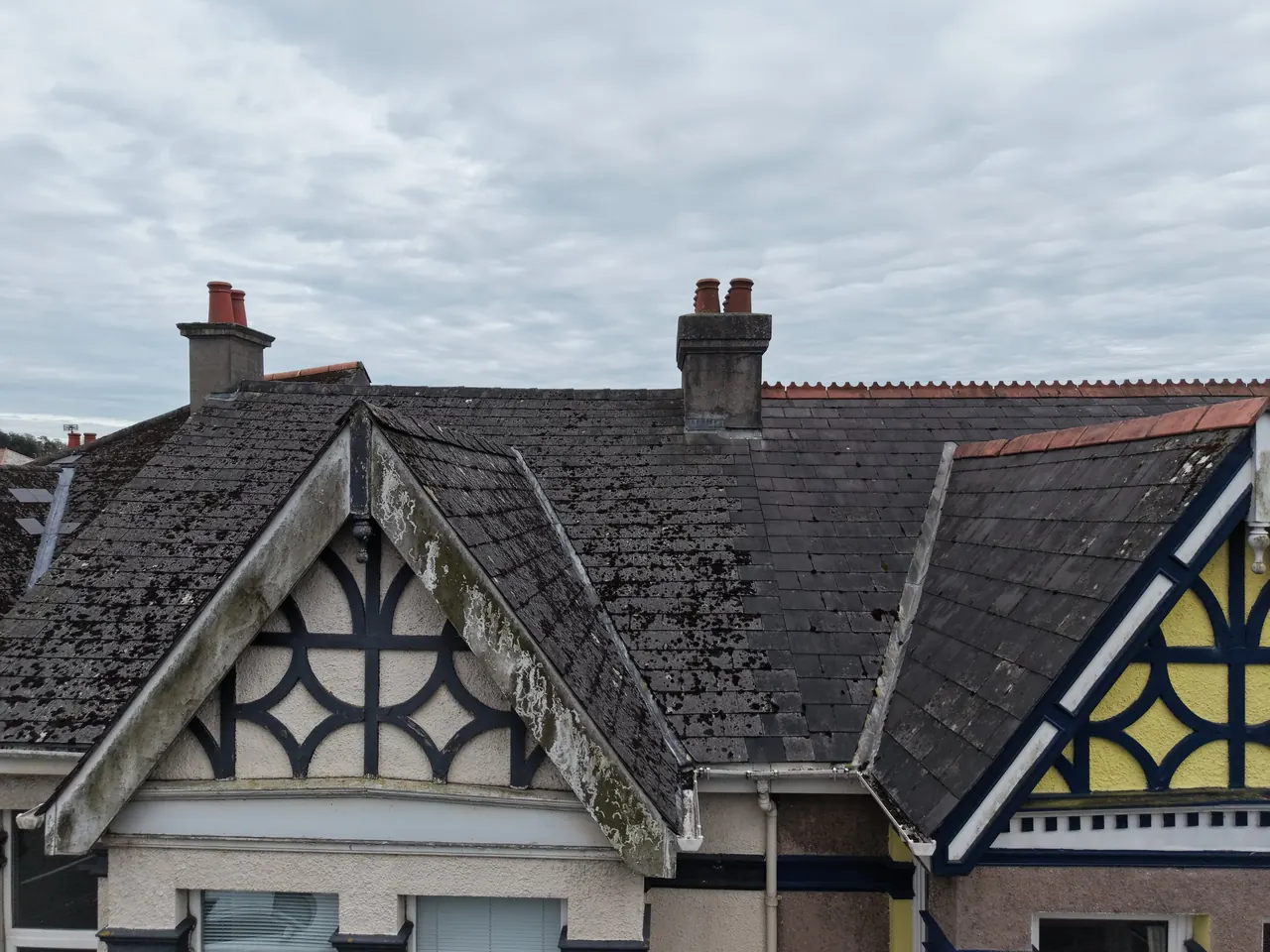
Ridge and hip tiles are bedded in mortar that cracks as the roof moves with wind and temperature. SPAB advises against strong cement mortars for bedding, because they crack, and recommends a more flexible bedding mortar. Signs to look for: gaps under ridge tiles, mortar crumbs in the gutter, or a ridge tile that has shifted.
Valleys and gullies are usually lined with lead and collect leaves and moss as well as water. Splits or debris can push water inside, often well away from where it appears. On Milehouse Road, a significant leak above a staircase was traced by drone to the lead-lined gully overhead, which Tom Duggan Roofing then replaced. See our gutter and valley inspection service.
What goes wrong around chimneys?
Usually the flashing, the flaunching or the stack itself. Chimneys are one of the most common sources of roof leaks.
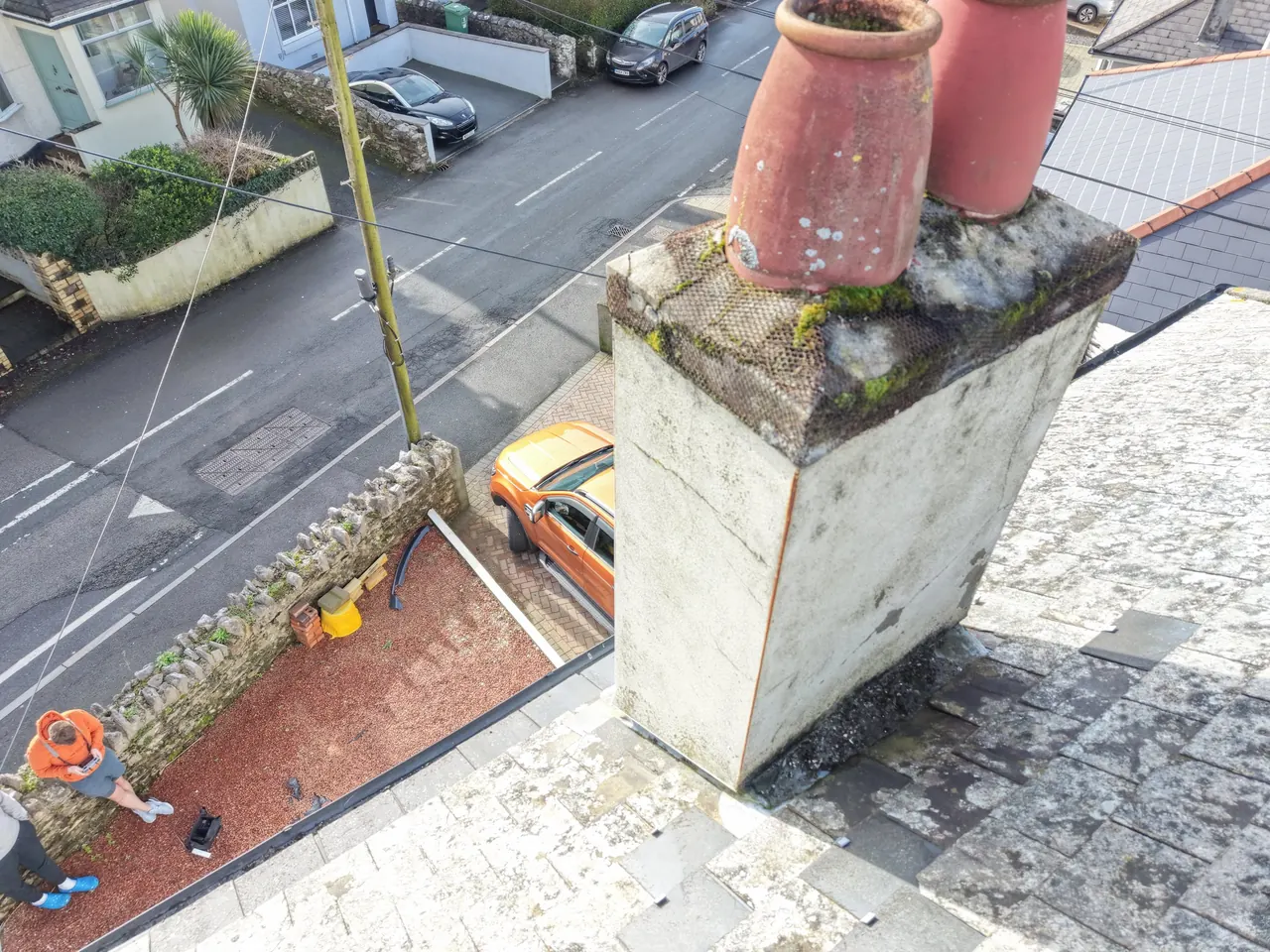
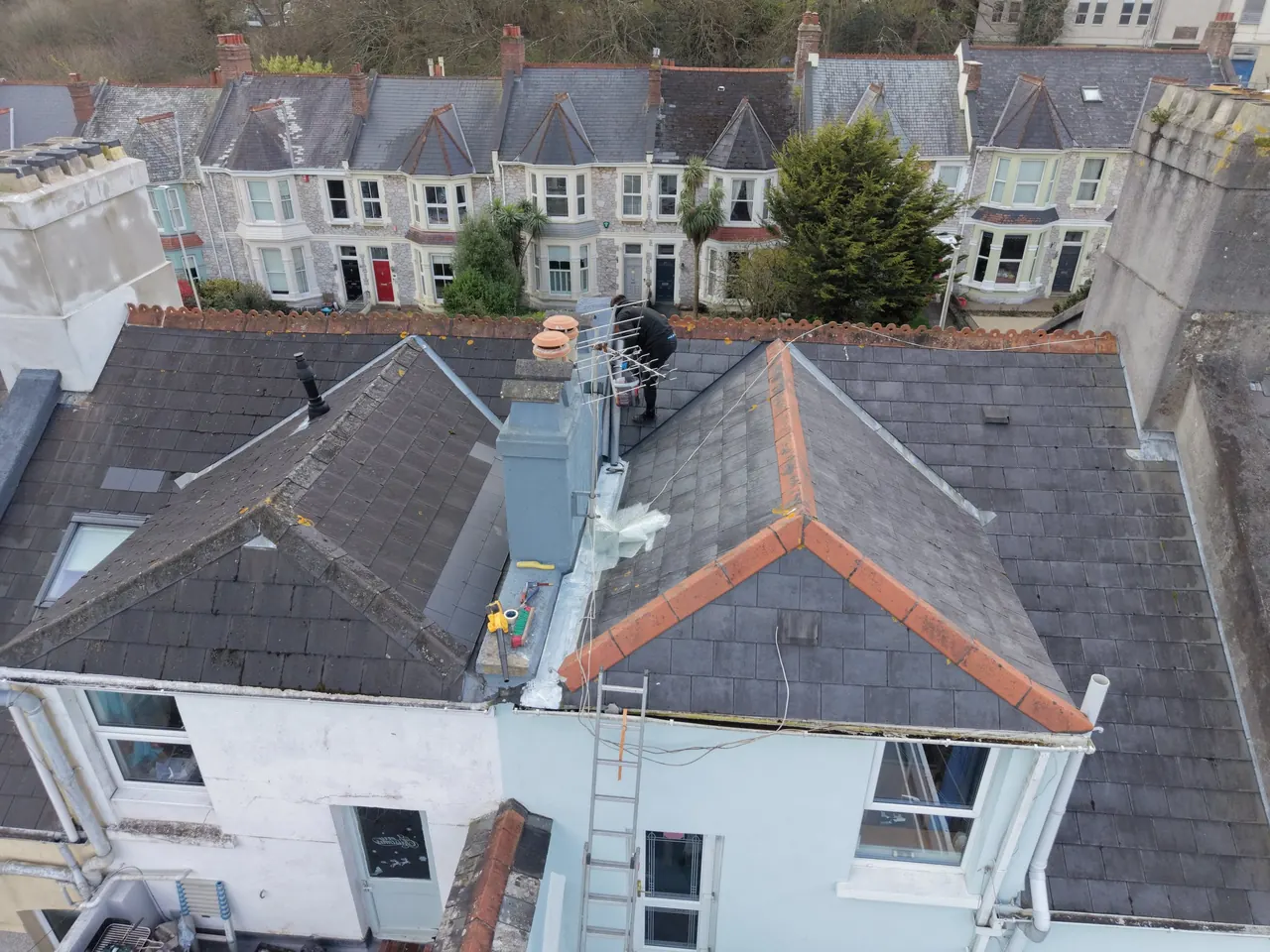
- Flashing is the lead that seals the joint between the stack and the slates. It can split, lift in the wind or go missing, and the mortar holding it into the brickwork can fall out.
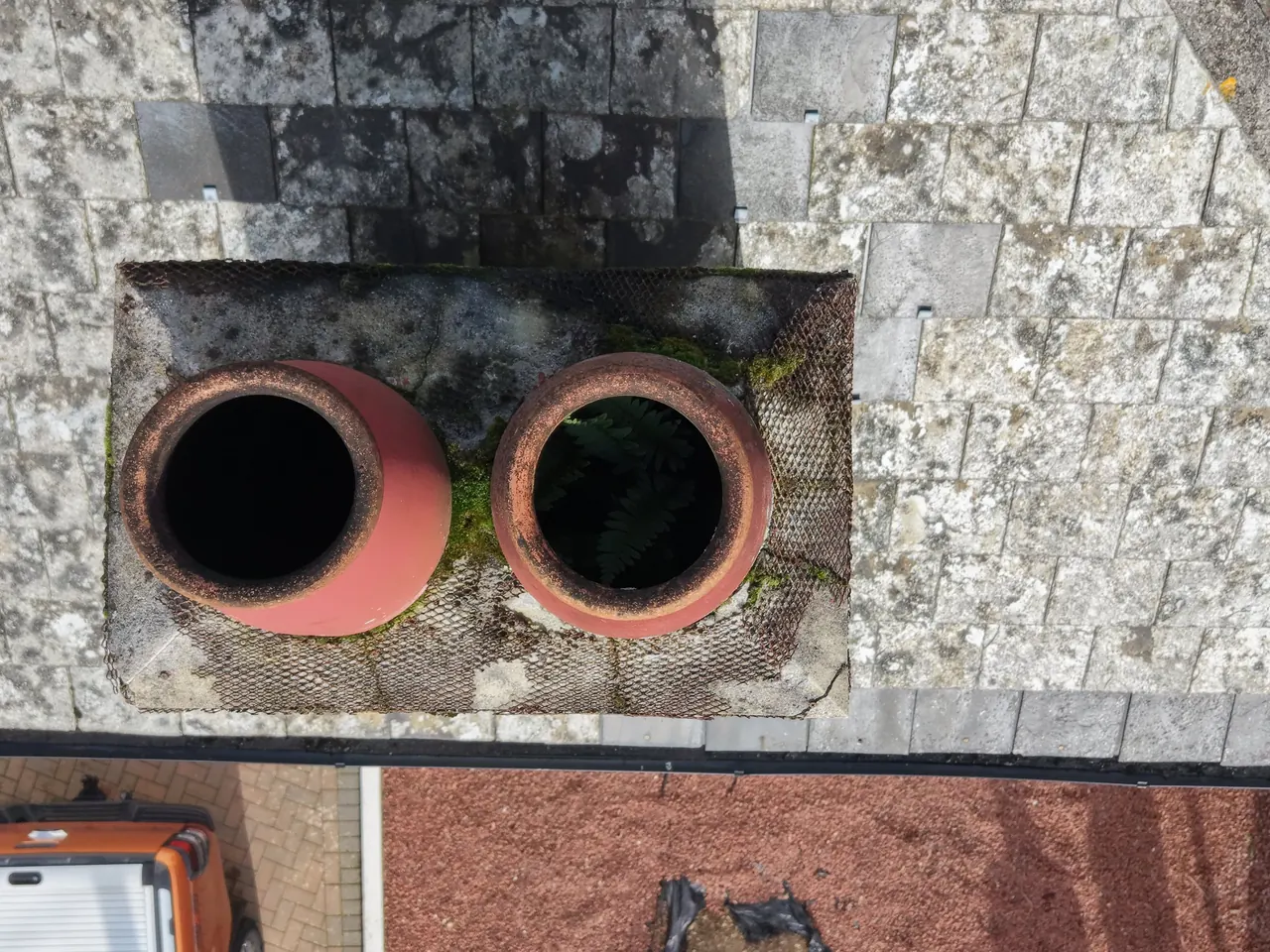
- Flaunching is the sloped mortar cap around the pots on top of the stack. When it cracks, water gets into the stack itself. You almost never see it from the ground.
- Pointing and masonry on the stack weather badly because chimneys stand above the roof and take the full force of driven rain.
In one of our Plymouth jobs, the owner suspected a leak around the chimney. The drone showed visible masonry defects and a section of missing flashing, which gave the roofer clear water entry points to fix rather than guesswork. See our chimney inspection service.
Is moss or lichen on slate a problem?
Lichen is usually cosmetic. Moss is worth dealing with once it builds up, mainly because of where it ends up.
Moss holds moisture against the roof, and clumps wash down into gutters, valleys and outlets, where they block the flow of water. We would avoid pressure-washing an old slate roof or having anyone walk across it: both can crack and dislodge slates. Professional moss removal typically costs £300-£700.
Should you repair or re-roof?
Repair if the problems are isolated. Consider re-roofing when slipping is spread across many courses, the roof surface is wavy, or repairs keep coming back.
A well-slated roof can last more than 100 years, according to SPAB, and sound old slates can often be reused. Historic England likewise says corroded nails do not automatically mean a whole new roof. These typical 2026 prices give a sense of scale:
| Job | Typical UK cost |
|---|---|
| Re-fix 3 slipped slates | £150-£220 |
| Ridge tile repair or repointing | £200-£550 |
| Lead flashing repair or replacement | £250-£700 |
| Chimney flashing repair | £300-£800 |
| Roof valley repair | £300-£900 |
| New slate roof, terraced house | £4,200-£5,800 |
| Scaffolding for roof work (if needed, 6-8 week minimum hire) | £450-£1,300 |
Figures are from MyJobQuote's 2026 cost guides. Check whether a quote includes VAT; scaffolding is usually quoted separately. Steep or complex roofs, natural slate and chimney rebuilds push quotes higher. Always get more than one written quote.
Do conservation area rules affect slate roof repairs in Plymouth?
They can. Plymouth has 15 conservation areas, including Mannamead and Stoke, and permitted development rights are reduced inside them.
Plymouth City Council lists changes such as cladding, windows, solar panels and extensions as ones that may need permission in conservation areas. Boundaries do not follow suburb names, so check the council's maps. Like-for-like repairs are the simplest route. Anything that changes the look of the roof, such as a different slate, new rooflights or solar panels, is worth checking with the council's planning team before work starts. Listed buildings need listed building consent for works that affect their character.
Historic England advises keeping existing ridges and retaining slate sizes, courses and the method of laying, particularly on stone slate roofs. For that kind of work, the NFRC Heritage Register lists roofers assessed for historic roofing.
What can a drone inspection see on a slate roof, and what can't it?
A drone shows the whole outer surface of the roof clearly, in close-up photos and 4K video. It cannot see what is hidden under the slates, including the nails.
What we see well:
- Missing, slipped and cracked slates, and how many tingles are already in place
- Ridge and hip mortar gaps and shifted ridge tiles
- Valleys, gullies and gutters, including debris and visible splits in the lead
- Chimney flashing, pointing, pots and flaunching
- Moss build-up, slurried areas and signs of earlier patch repairs
What we can't see:
- The nails themselves, which sit under the overlapping slate above
- Battens, underlay, sarking and roof timbers
- Moisture or rot inside the roof
So a drone can show the symptoms of nail sickness, such as slipped slates and sagging courses, but not confirm the condition of every nail. For that, a roofer needs to lift slates. A loft check for daylight or damp staining is a useful companion. Our inspections are visual only, not a structural survey, and every flight depends on the weather and airspace.
Buying an older Plymouth home? See our pre-purchase roof check. Related reading: how to find a roof leak and what a drone roof inspection costs in Plymouth.
Next step
If you have spotted slipped slates, a damp patch near the chimney or a gutter full of grit, a drone roof inspection is the quickest way to see the whole roof without scaffolding. A targeted check of one area costs £75, a full roof inspection £150, and a full inspection with an annotated PDF report £200 (see pricing). We cover Plymouth and offer a free 15-minute call. Get in touch and tell us what you have noticed.
Frequently asked questions
How long does a slate roof last?
The slate itself can last hundreds of years, and SPAB puts the life of a well-slated roof at more than 100 years. In practice the fixings set the limit: iron nails rust and battens rot long before good slate wears out. That is why older roofs are often re-slated using many of the original slates rather than replaced with new ones.
Can I walk on my slate roof to check it?
We would advise against it. Slate is brittle and cracks under foot, and SPAB lists people walking on roofs as one cause of broken slates. Steep pitches, wet moss and fragile old fixings also make it dangerous. Look from the ground with binoculars, check the loft, or use a drone or a roofer with proper access equipment.
Will my insurer pay for nail sickness?
Usually not. Nail sickness is gradual deterioration, and most home insurance policies exclude wear and tear. Insurers generally cover sudden events such as storm damage, but if a roof was already in poor condition, a claim can be declined. Keeping dated photos of your roof's condition helps show what changed after a specific event.
Do I need permission to replace slates in a Plymouth conservation area?
Like-for-like repairs are normally the simplest route, but rules depend on the property and the work. Changing the type of slate or adding rooflights or solar panels in one of Plymouth's 15 conservation areas may need consent, and listed buildings need listed building consent for works affecting their character. Check with Plymouth City Council's planning team first.
Sources
- Historic England: Repair or renew the roof in an older home
- SPAB: Slating in South-West England, Regional Technical Advice Note
- Met Office: South West England climate
- Plymouth City Council: Conservation areas
- MyJobQuote: How much does a slate roof cost? (October 2026)
- MyJobQuote: Roof repair costs (October 2026)
- NFRC Heritage Register